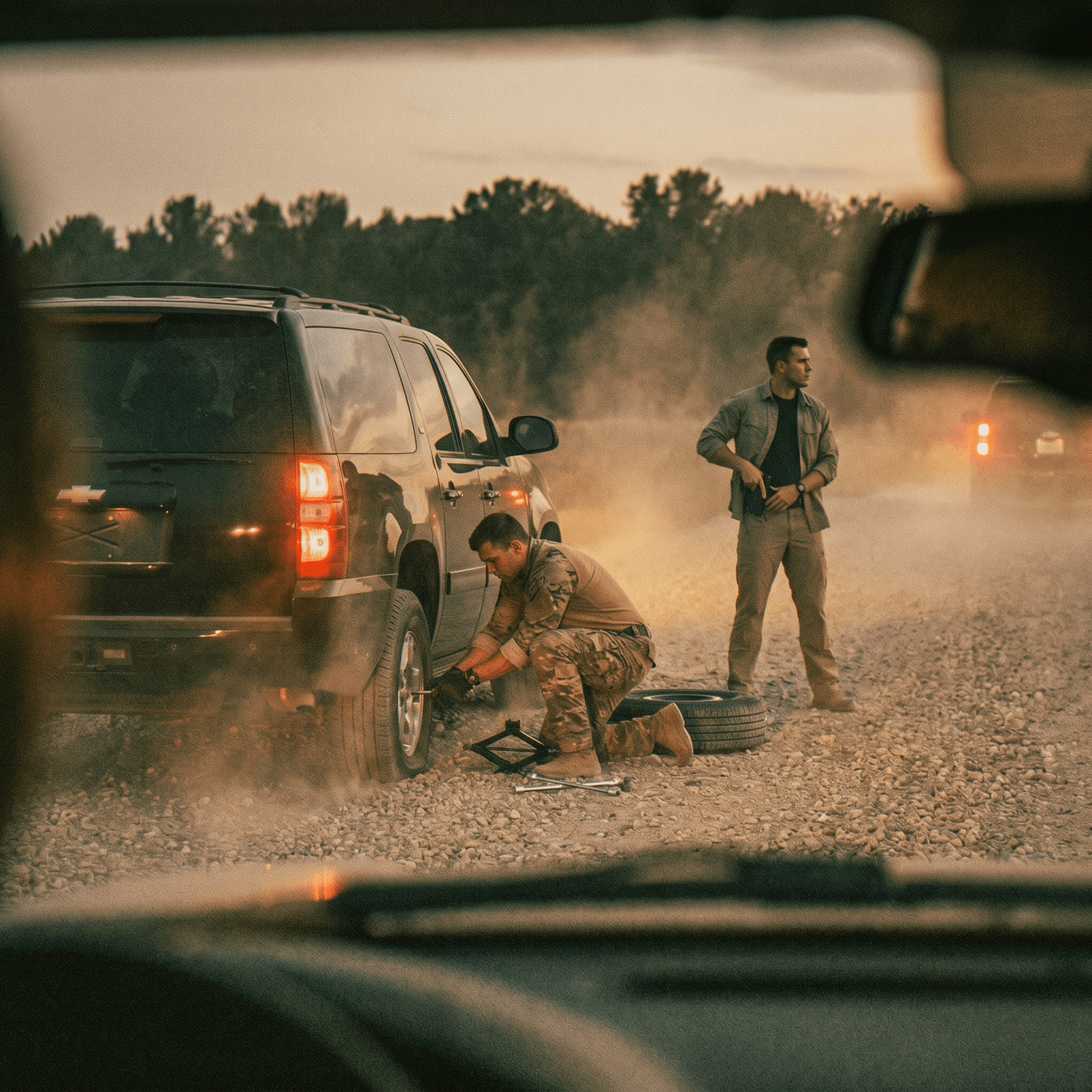
Tactical Vehicle Operations, Defined
Tactical Vehicle Operations is the discipline of fighting from, around, and through vehicles. It is sometimes called vehicle CQB, and it covers the close-range problems that arise when a vehicle is part of a deadly-force encounter. That means drawing and shooting from inside a cramped cab, using the vehicle for protection, exiting under fire, and moving to better positions on foot. It is not a driving course. It is a gunfighting course that happens to take place where most fights actually occur.
The reason this skill set matters is simple. A large share of deadly-force encounters involve a vehicle in some way. A routine traffic stop escalates. An ambush opens on a parked unit. A protective detail has to get a principal into or out of a car while rounds are inbound. The vehicle is rarely a neutral backdrop. It is the terrain, the obstacle, and sometimes the only protection within reach. If you carry a firearm for a living, or for self-defense, you are statistically more likely to use it near a vehicle than anywhere else.
Cover Versus Concealment, and the Ballistic Reality
The first lesson is the most important and the most misunderstood. A vehicle is mostly concealment, not cover. Concealment hides you. Cover stops bullets. Most of a car does neither against rifle rounds, and far less of it stops handgun rounds than people assume. Door skins, glass, and sheet metal are concealment. They break up a shooter's sight picture but will not reliably defeat incoming fire.
A small number of points on a vehicle do offer real ballistic protection. The engine block, the wheels and axles, and the steel of the pillars are the dense structures worth getting behind. Good training teaches you to read a vehicle instantly and put hard parts between you and the threat. It also teaches the angles that glass and sheet metal impart to a bullet, because rounds deflect along surfaces in ways that change where you should and should not place your body.
FIELD NOTE —Field note: rounds that strike a windshield or a hood often skip and travel along the surface rather than punching straight through. Knowing that changes where you stand.
What Is Actually Trained
A serious Tactical Vehicle Operations course is built around the problems that get people killed, drilled until they are automatic. The core blocks are consistent across credible programs.
- Shooting from inside the vehicle. Drawing in a confined space, clearing the seatbelt, managing the muzzle, and engaging through or around the windshield and side glass.
- Rapid entries and exits under threat. Getting out of a vehicle fast and clean, getting to a protected position, and getting back in when the mission requires it.
- Shooting around and over the vehicle. Working the hood, the trunk, the wheel wells, and the pillars while exposing as little of yourself as possible.
- Working with a partner. Communicating, deconflicting muzzles, and moving as a pair so one person covers while the other repositions.
- Malfunction and transition under stress. Clearing stoppages and transitioning from carbine to pistol in tight quarters, where there is no room for a clean, square-range reload.
The work starts dry and slow, then builds to live fire at speed. Repetition is the point. Under stress you default to what you have rehearsed, so the rehearsal has to be correct and frequent.
Who Needs This, and Where It Gets Trained
Law enforcement is the first audience. Officers spend their shifts in and around vehicles, and the traffic stop remains one of the most dangerous things they do. For Texas officers, qualifying courses also count toward continuing education, since The Benjamin Guard is TCOLE accredited through Grayson College. Armed civilians are the second audience. If you carry, your car is where you spend a great deal of your day, and a carjacking or road-rage attack puts you in exactly this fight with none of the structure a duty environment provides.
This training is hard to do realistically because it demands real vehicles and live fire on the same range. At The Benjamin Guard, that happens in the Dynamic Bay, a live-fire range 150 yards deep by 100 yards wide where vehicles, buses, and aircraft fuselages are brought in for scenario work. The Tactical Vehicle Operations course, run as Mobile Threat Interdiction, is a two-day block held in that bay so students fight around the real thing, not a static prop. Seats are limited and the course runs with a minimum cohort, so plan ahead.
If you carry a firearm and want to be ready where the fight actually happens, review the schedule and reserve a seat at /training.